

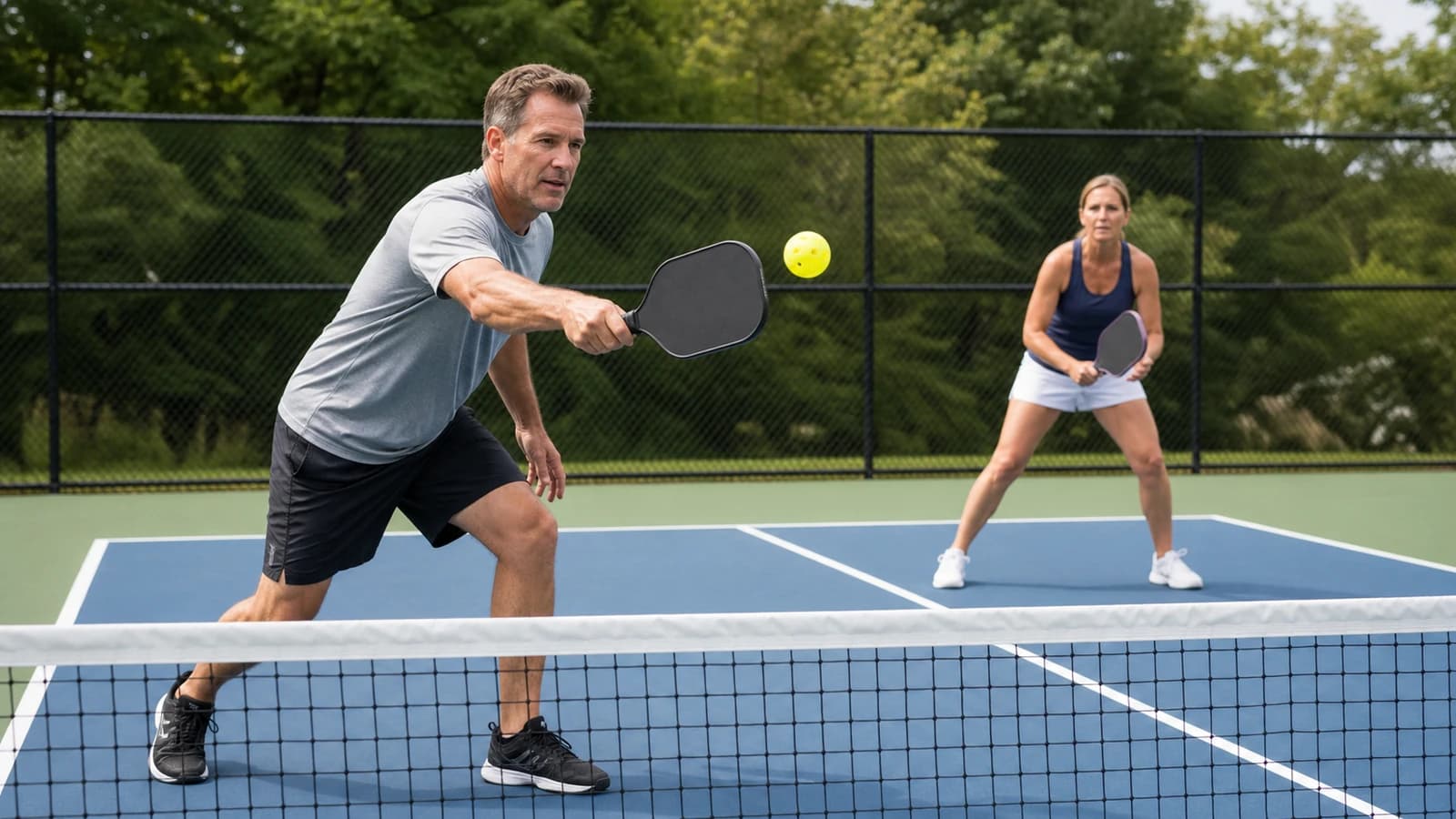
Quick Answer
Compare the complete court system—not a material label.
There is no universally best pickleball court surface. Start with the court's job and site conditions, then compare the structural base, drainage, playing layer, edge transitions, maintenance plan, and evidence for the exact system. Standard acrylic, cushioned acrylic, a bare hard base, and modular tile can each fit a project, but the material name alone does not establish ball response, traction, comfort, durability, or total cost.
On this page
Start with the court's job and usable playing area
A surface decision begins before a product is named. Define whether the court is for occasional backyard play, daily club use, a school, a community facility, a temporary event, or a shared multi-sport space. Record who maintains it, how quickly play is expected to resume after rain, whether the court may move or change, and which local accessibility, permitting, setback, drainage, or facility rules apply.
USA Pickleball identifies 20 by 44 feet as the playing-line dimensions. Its current construction guidance recommends a larger total playing surface: 30 by 60 feet minimum and 34 by 64 feet preferred. Those figures help establish planning scale, but they do not approve a particular site, base, clearance, slope, or surface system.
Before comparing finishes, document the existing ground or slab, visible cracks and low areas, drainage route, shade and debris, sun exposure, temperature range, freeze-thaw conditions, surrounding edges, fixed posts, and equipment access. A sample can show color and texture; it cannot reproduce the base interaction, water movement, joints, transitions, or play of a completed court.
- Primary use, player volume, operating hours, and multi-sport needs
- Indoor, outdoor, temporary, or permanent setting
- New construction, sound existing base, or renovation with known defects
- Maintenance owner, inspection frequency, cleaning access, and planned downtime
- Local site, accessibility, drainage, permit, and professional-review requirements
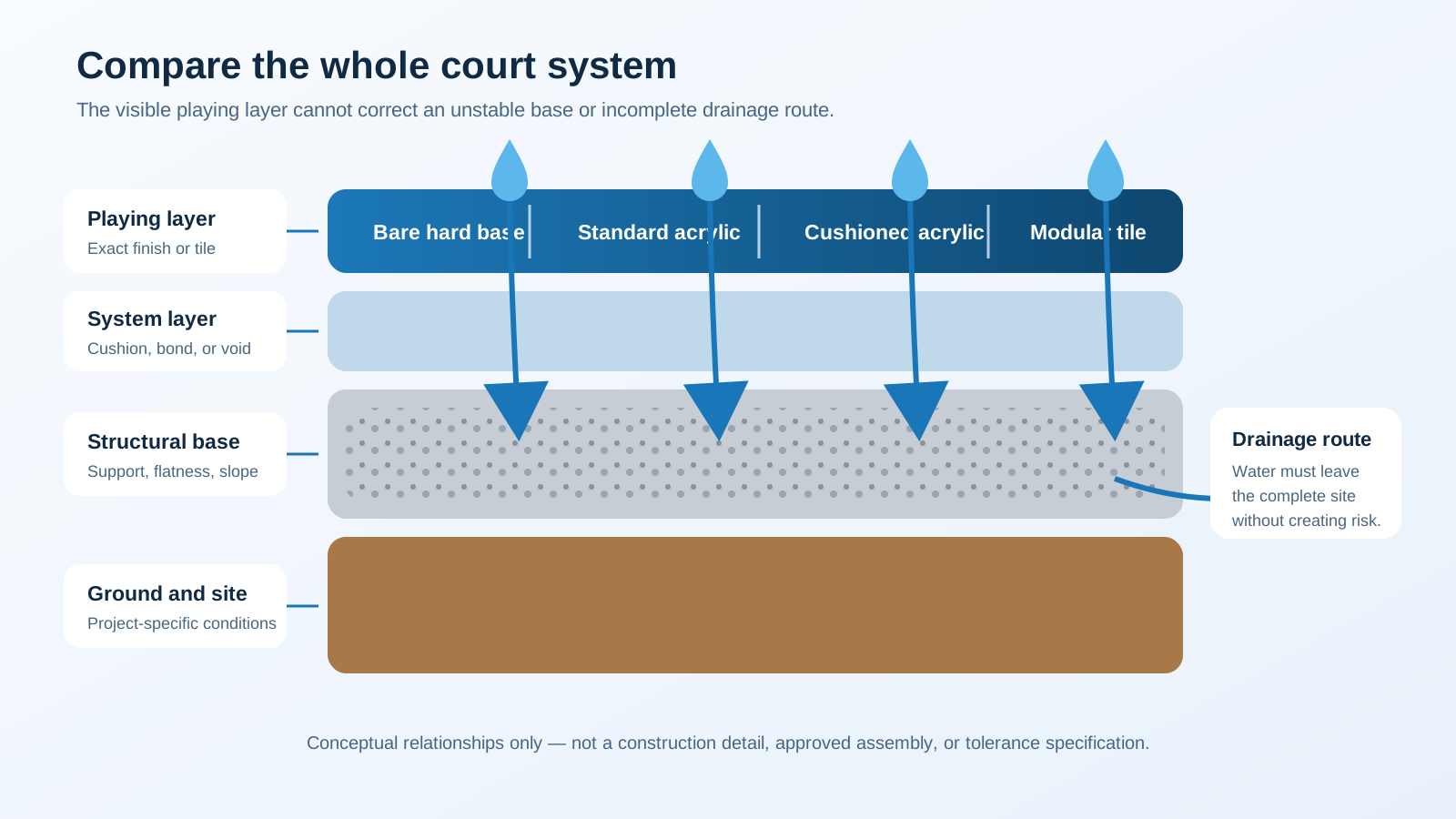
Separate the base from the playing surface
The word surface often hides several layers. Concrete or asphalt may be the structural base and, in a basic recreation setting, may also be the exposed playing surface. An acrylic system is a prepared coating build-up over a compatible hard base. A cushioned acrylic system adds resilient layers beneath the color finish. A modular system places connected tiles over a suitable subsurface and still depends on that base for support, geometry, and water management.
USA Pickleball describes both asphalt and concrete as acceptable court bases when surfacing requirements for slope, drainage, finish, and overall construction are addressed. Its guidance recommends 100% acrylic coatings for pickleball and athletic courts, but that recommendation does not make every acrylic formulation, slab, installer, or finished court equivalent.
Commercial system pages illustrate why product-level review matters. SportMaster publishes substrate preparation and application conditions for its PickleMaster acrylic system. Sport Court publishes a pickleball-specific modular tile with its own construction and documents. These sources describe named products, not automatic properties of every acrylic coating or plastic tile.
| Surface system | Often considered for | Potential strengths | Important questions and trade-offs |
|---|---|---|---|
| Bare concrete or asphalt | Informal recreation, temporary line layouts, or an existing hard area used without a dedicated sports finish. | Few added layers and direct use of an existing sound area; concrete and asphalt remain distinct base materials. | Hardness, texture, cracks, heat, abrasion, ponding, line adhesion, and maintenance depend on the exact base and condition. A hard surface being playable does not make it a finished court specification. |
| Standard acrylic over a hard base | Permanent courts seeking a continuous colored finish, textured playing layer, and painted markings. | The complete specified system can provide a familiar hard-court appearance and a renewable finished layer. | It cannot stabilize a moving base or correct poor drainage. Preparation, cure conditions, texture, wet-use rules, crack behavior, and recoating belong to the named system and site. |
| Cushioned acrylic system | Projects considering a continuous acrylic finish with specified resilient layers beneath it. | A named system may document additional shock response or player-comfort characteristics while retaining an acrylic top finish. | More layers do not prove a health outcome. Ask how the exact build-up affects ball response, repairs, recoating, installation conditions, warranty, and lifecycle cost. |
| Modular sports tile system | Existing hard-base conversions, multi-sport areas, component-replaceable fields, or projects valuing a modular installation approach. | Some named open-grid systems document drainage through the playing layer, replaceable components, or pickleball-specific geometry. | The base still matters. Confirm ball response, joints, texture, wet-use guidance, thermal movement, edge transitions, anchoring, cleaning, and whether evidence covers the exact tile and installed assembly. |
Bare concrete or asphalt
- Often considered for
- Informal recreation, temporary line layouts, or an existing hard area used without a dedicated sports finish.
- Potential strengths
- Few added layers and direct use of an existing sound area; concrete and asphalt remain distinct base materials.
- Important questions and trade-offs
- Hardness, texture, cracks, heat, abrasion, ponding, line adhesion, and maintenance depend on the exact base and condition. A hard surface being playable does not make it a finished court specification.
Standard acrylic over a hard base
- Often considered for
- Permanent courts seeking a continuous colored finish, textured playing layer, and painted markings.
- Potential strengths
- The complete specified system can provide a familiar hard-court appearance and a renewable finished layer.
- Important questions and trade-offs
- It cannot stabilize a moving base or correct poor drainage. Preparation, cure conditions, texture, wet-use rules, crack behavior, and recoating belong to the named system and site.
Cushioned acrylic system
- Often considered for
- Projects considering a continuous acrylic finish with specified resilient layers beneath it.
- Potential strengths
- A named system may document additional shock response or player-comfort characteristics while retaining an acrylic top finish.
- Important questions and trade-offs
- More layers do not prove a health outcome. Ask how the exact build-up affects ball response, repairs, recoating, installation conditions, warranty, and lifecycle cost.
Modular sports tile system
- Often considered for
- Existing hard-base conversions, multi-sport areas, component-replaceable fields, or projects valuing a modular installation approach.
- Potential strengths
- Some named open-grid systems document drainage through the playing layer, replaceable components, or pickleball-specific geometry.
- Important questions and trade-offs
- The base still matters. Confirm ball response, joints, texture, wet-use guidance, thermal movement, edge transitions, anchoring, cleaning, and whether evidence covers the exact tile and installed assembly.
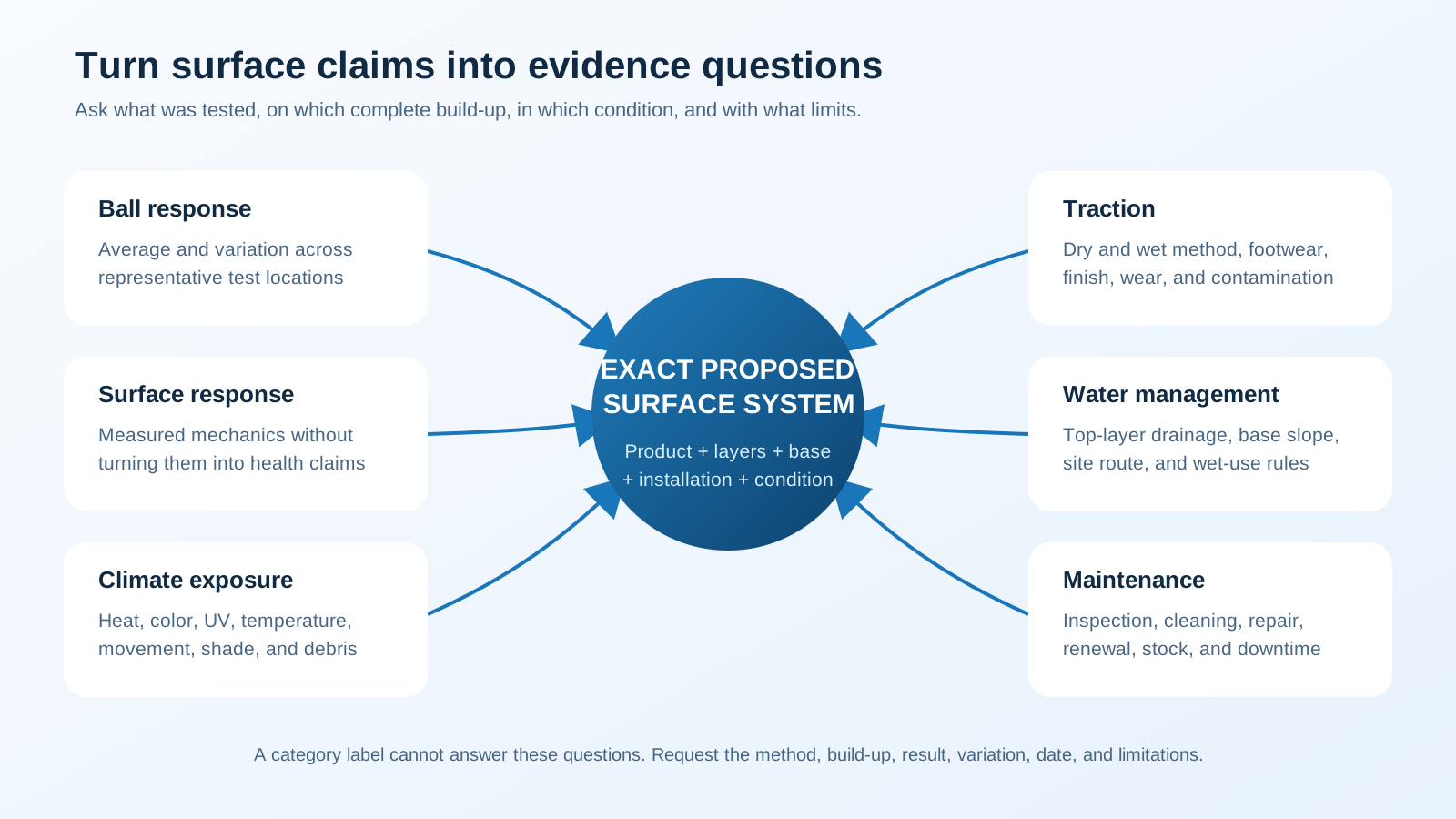
Evaluate play with evidence for the exact system
USA Pickleball's Equipment Standards Manual provides a ball-compliance baseline, not a court rating: the ball must rebound 30 to 34 inches to its top after being dropped 78 inches onto the specified granite plate at 70°F ± 5°F. This fixed-reference test qualifies the ball; it does not establish a universal court-surface percentage or rank acrylic, concrete, and tile.
A court-surface percentage requires the named ball, complete system, reference surface, and method. ASTM F2117-10(2024) covers quantitative, normalized vertical rebound for sports surface/ball systems. Sport Court reports 100% ball rebound under EN 12235 for SportGame PB, but its public sheet omits the test ball, drop height, conditioning, locations, reference result, variation, and laboratory report. Treat this as an attributed product result—not a universal modular-tile value or direct acrylic comparison—and request representative-location averages and variation.
Traction claims require the exact finish, footwear, contamination, wear, and dry or wet condition. Water passing through a top layer does not make play safe during rain or contamination. Follow the manufacturer's wet-use and cleaning guidance.
A cushioned coating or flexible tile may have documented mechanical behavior, but terms such as softer, shock absorbing, or joint friendly do not establish injury prevention. Review the method, assembly, measured property, limits, and trade-offs with stability, ball response, transitions, and maintenance.
- Ball response level and uniformity across representative locations
- Dry and wet traction methods, surface condition, footwear, and contamination
- Surface consistency at seams, repairs, painted lines, and transitions
- Mechanical cushioning evidence without converting it into a medical promise
- How results change with the actual base, underlay, installation, temperature, and wear
Make climate, drainage, and maintenance part of selection
Outdoor exposure affects the full system. Water has to leave the playing area and the site safely; passing through an open-grid tile does not correct a base that ponds or sends water toward a building. Coatings likewise depend on compatible slope, drainage, substrate preparation, and moisture conditions. Persistent wetness, heaving, settlement, or structural movement requires qualified site review rather than another finish layer.
Heat and sun deserve more than a generic material claim. USA Pickleball notes that lighter court colors absorb less solar heat than darker colors and that contrast affects ball visibility. Actual surface temperature also depends on color, exposure, air movement, time of day, and the complete system. Ask for relevant data and do not convert a color choice into a comfort guarantee.
Cold climates add subgrade, frost, moisture, and movement questions. Hot climates add expansion, coating-application, fading, and touch-temperature questions. Wet or shaded sites add algae, leaves, drying, and cleaning concerns. The inspection plan should cover cracks, low areas, loose or damaged components, worn texture, line visibility, abrupt edges, blocked drainage, organic growth, and any change that affects predictable footing or play.
Maintenance is system-specific. USA Pickleball describes resurfacing as cleaning, repairing cracks and low areas, applying base and color coatings, and restriping. Modular systems may allow access to the base or individual component replacement, but the procedure, availability, warranty effect, and safe return-to-play decision must come from the selected supplier.
Compare lifecycle cost instead of one surface price
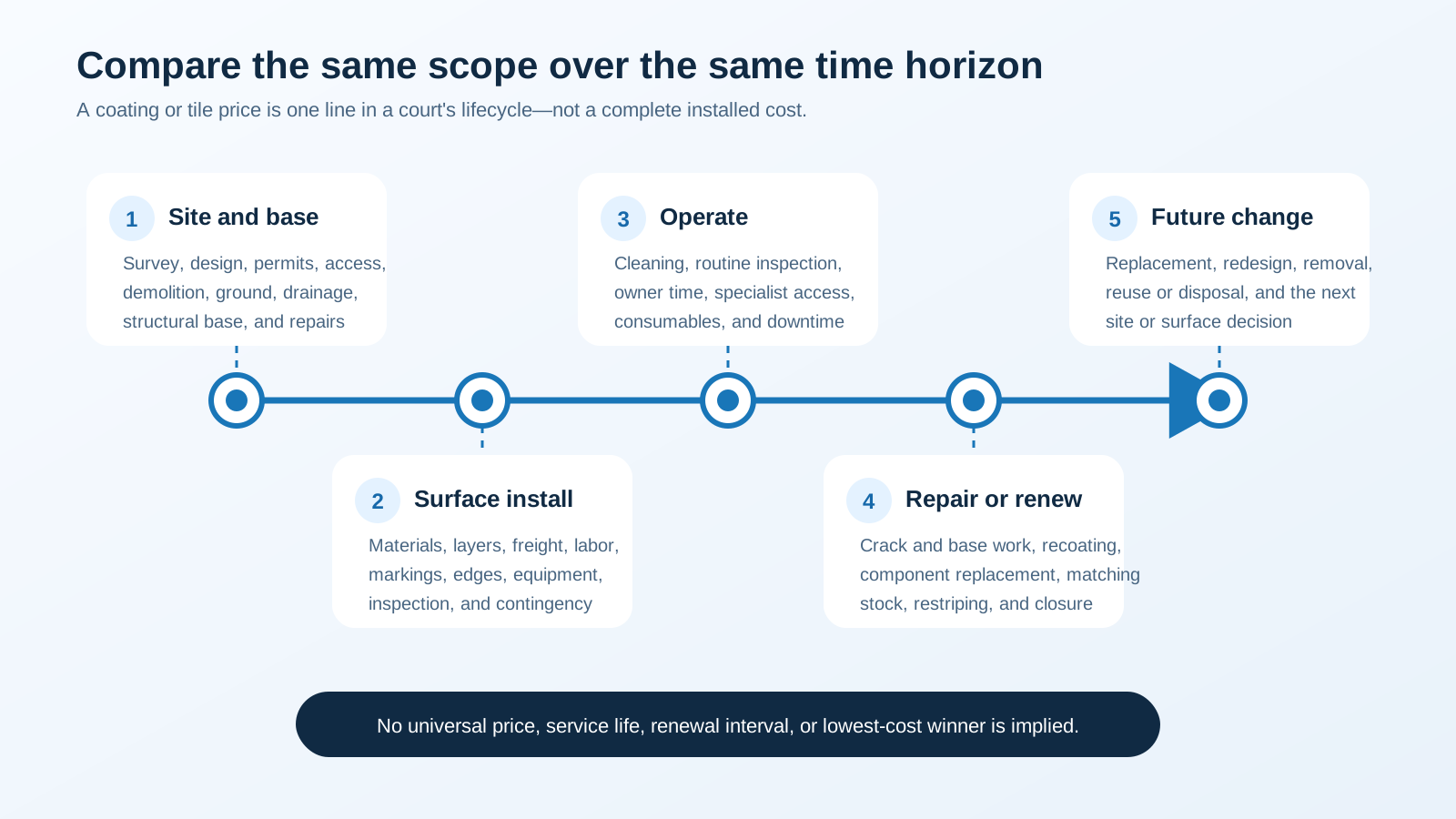
Published per-court prices are rarely comparable without location, date, court area, base condition, access, drainage, labor scope, and inclusions. A surface-material quote may exclude the most consequential site work. For that reason, this guide does not publish a universal installed price, service life, or resurfacing interval.
Build a like-for-like cost schedule. Separate survey and design, permits, demolition, grading, drainage, subgrade, structural base, crack or moisture work, playing surface, cushion layers, markings, transitions, equipment foundations, freight, installation labor, cleaning, inspections, repairs, recoating, replacement components, disposal, downtime, and contingency. Identify allowances and exclusions rather than hiding them inside a single total.
Then compare the operating horizon. A lower initial price can carry more frequent renewal, specialist access, or downtime. A replaceable component can reduce one repair scope while still leaving base work or matching-stock risk. A durable base may still require surface renewal. Use the supplier's written maintenance and warranty conditions, a local professional's site assessment, and realistic responsibility for future work.
- Initial site and base work
- Surface materials, accessories, freight, and installation
- Scheduled cleaning, inspection, and renewal
- Likely repair access, replacement stock, and downtime
- Warranty scope, exclusions, remedies, and owner obligations
- End-of-life removal, reuse, or disposal
Match the system to the project scenario
A new permanent dedicated court can start with coordinated site, base, drainage, surfacing, equipment, and maintenance decisions. That does not automatically select concrete over asphalt or acrylic over tile; local ground, climate, contractor capability, use intensity, evidence, and operating plan still control the choice.
An existing hard-base conversion begins with condition, not convenience. Document cracks, movement, low areas, moisture, slope, finish, and edge relationships before deciding whether repair, resurfacing, overlay, modular coverage, or reconstruction is appropriate. A new top layer should not conceal an active problem or create an abrupt transition.
A multi-sport or removable court adds line hierarchy, equipment conflicts, storage, assembly, movement, and different ball-response expectations. Indoor play adds floor protection, dust, moisture, footwear, glare, acoustic, and facility-maintenance questions. Wood, rubber, rolled surfaces, and portable systems should be evaluated as named assemblies; their category names do not prove pickleball suitability.
In every scenario, the responsible decision is conditional: choose the system whose documented requirements and trade-offs fit the real site and operating plan. If evidence is missing, record the gap instead of filling it with a best-surface label.
Use a supplier checklist before choosing
Ask every bidder to identify the exact product names, layer sequence, thicknesses where relevant, structural base assumptions, drainage concept, edge conditions, markings, accessories, and work excluded from the quote. Require current documents rather than a generic brochure or a sample from another system.
Request evidence in a comparable form: method, specimen or installed build-up, conditioning, result, variation, date, and limitations. Ask whether ball response, traction, weathering, cushioning, temperature, and load information applies to the proposed product, color, base, and environment. Confirm who is responsible for design, preparation, installation, inspection, maintenance, repairs, and return-to-play decisions.
- What exact base and surface system is proposed, and what site assumptions does it depend on?
- Which product-specific ball response and traction evidence is available, including wet-condition scope?
- How are drainage, thermal movement, cracks, joints, edges, posts, and accessibility transitions addressed?
- What cleaning, inspection, repair, resurfacing, spare-part, and downtime plan is required?
- What does the quote include and exclude, and which allowances may change after site work begins?
- What does the written warranty cover, exclude, and require from the owner?
- Which claims remain unverified, and who is qualified to resolve them before purchase?
Frequently Asked Questions
Pickleball court surface FAQ
What is the best surface for a pickleball court?
There is no universal best. A suitable choice depends on the court's use, base, drainage, climate, maintenance owner, budget horizon, and evidence for the exact system. Standard acrylic may suit a permanent continuous finish; cushioned acrylic may be considered when a documented resilient build-up matters; modular tile may fit some conversions or multi-sport projects; and a bare hard area may support informal play. Compare named systems and full scopes rather than category rankings.
Are concrete and asphalt playing surfaces or bases?
They can be either, depending on the project. A sound hard area may be used directly for informal play, while permanent courts often use concrete or asphalt as the base beneath an acrylic or modular surface system. USA Pickleball considers both acceptable bases when slope, drainage, finish, surfacing, and overall construction requirements are addressed. The material name alone does not approve the condition or design.
Sources: [1]
Does modular tile drain better than acrylic?
Some named open-grid tiles are designed to let water pass through the playing layer, while a continuous acrylic court moves water across its sloped surface. That is not a complete better-or-worse comparison. The base and site still need a safe drainage route, and wet-use rules remain product-specific. Ask how the complete proposed system handles water, debris, drying, cleaning, ponding, and return to play.
Is a cushioned surface safer for players?
A named cushioned system may document shock response or a more resilient feel, but that does not establish injury prevention or universal safety. Review the exact assembly, test method, measured property, transitions, stability, traction, maintenance, and limitations. Player health questions should not be answered by turning a material description into a medical promise.
How much does a pickleball court surface cost?
A reliable figure requires a location, date, measured area, site access, existing conditions, base and drainage scope, selected system, markings, transitions, freight, labor, maintenance, and exclusions. A tile or coating price is not a complete installed court cost. Compare itemized quotes over the same lifecycle horizon rather than relying on a universal per-court number.
Can a physical sample tell me how the finished court will play?
A sample can help evaluate visible color, texture, thickness, and component construction. It cannot reproduce a full field, base interaction, seams, moisture, drainage, transitions, temperature, installation, wear, or ball response across multiple points. Use it alongside product documents, relevant test evidence, completed-system references, and site-specific professional review.
How this guide was prepared
Courtily reviewed USA Pickleball guidance and its American Sports Builders Association manual page, plus official information for one acrylic and one pickleball-specific modular system. Product claims were attributed, not generalized by material.
Rebound sources were kept separate: USA Pickleball for ball compliance, ASTM F2117 for test-method context, and Sport Court's 100% EN 12235 figure only as an attributed SportGame PB result with disclosed reporting gaps.
Selkirk, Pickleland, and Pickletile comparisons informed the reader questions covered. Their wording, rankings, prices, lifespan claims, and images were neither copied nor treated as technical authority.
Aoife O’Hanlon completed Courtily’s internal editorial and product-scope review on September 6, 2026. The review draws on first-hand manufacturing, assembly, and full-court installation experience, but it is not independent engineering advice, laboratory testing, certification, or a substitute for current product documents and qualified site advice.
What Courtily verified
- The article preserves the approved pickleball court surface keyword ownership, URL, title, H1, and description.
- The Hero is a Courtily-generated editorial visualization, and the three diagrams are original Courtily educational graphics.
- No Courtily product is named or presented as the preferred pickleball surface in this guide.
Commercial disclosure and scope
Courtily sells Court Tiles, offers physical samples, and provides paid digital Custom Design for layout and quantity guidance. This guide intentionally does not recommend a specific Courtily product. Courtily does not claim to provide subsurface engineering, concrete or asphalt construction, drainage design, professional installation, permitting, site inspection, medical advice, or universal product suitability. Links to Courtily's catalog and services are commercial links.